Introduction
In today’s competitive digital world, businesses need effective advertising strategies to attract customers, generate leads, and increase sales. Two popular platforms for online advertising are Google Ads and Meta Ads. Both help businesses reach potential customers, but they work in different ways.
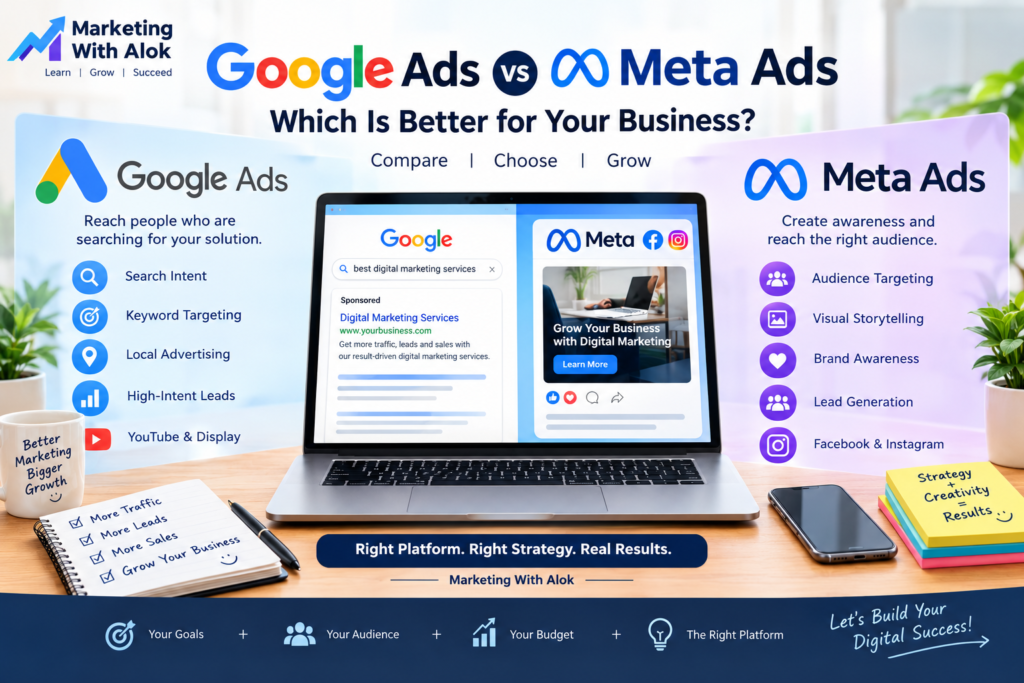
Google Ads helps businesses connect with people searching for products or services. Meta Ads, which includes advertising on Facebook and Instagram, helps businesses reach people based on audience characteristics, interests, and activity across Meta’s advertising ecosystem.
But which platform is better for your business? Should you invest in Google Ads, Meta Ads, or both?
The answer depends on your business goals, target audience, product or service, advertising budget, and how customers make purchasing decisions. In this guide, we will compare Google Ads vs Meta Ads and explain how to choose the right strategy for your business.
What Are Google Ads?
Google Ads is Google’s online advertising platform. It allows businesses to promote products and services across eligible Google advertising placements, including Google Search, YouTube, and other participating properties.
For example, imagine someone searches for “best digital marketing agency near me.” A relevant business running a Google Search campaign may appear among the sponsored results.
This makes Google Ads useful for reaching people who are actively searching for a particular product, service, or solution.
Benefits of Google Ads
- Reach customers with purchase intent: Connect with people searching for relevant products or services.
- Keyword targeting: Choose search terms related to your business and advertising goals.
- Local advertising: Target relevant locations to reach nearby customers.
- Measurable performance: Track clicks, calls, leads, conversions, and sales when tracking is configured correctly.
- Flexible campaign options: Choose suitable formats and campaign types based on your goals.
Who Should Use Google Ads?
Google Ads can be a strong option for businesses whose customers actively search for their services. Examples include plumbers, coaching institutes, clinics, consultants, repair services, software providers, and digital marketing agencies.
For example, a digital marketing freelancer could target relevant searches such as “SEO services for small businesses” or “Google Ads expert in Noida.” Results will depend on competition, keyword relevance, campaign quality, and the landing page experience.
What Are Meta Ads?
Meta Ads is the advertising platform used to create campaigns across eligible Meta placements, including Facebook and Instagram. Depending on the campaign setup, businesses can use images, videos, Reels, Stories, carousels, and lead forms.
Unlike a typical Google Search ad, a Meta ad often reaches people while they are browsing social media rather than actively searching for a product.
For example, a clothing brand can show a new collection to a relevant audience using engaging product videos. A coaching institute can promote an upcoming course, while a local restaurant can advertise a special offer to people in its service area.
Benefits of Meta Ads
- Audience targeting: Reach relevant audiences using available targeting options.
- Visual storytelling: Demonstrate products and services through images and videos.
- Brand awareness: Introduce your business to potential customers.
- Lead generation: Collect enquiries through suitable lead-generation formats.
- Remarketing opportunities: Re-engage eligible audiences who have interacted with your business, subject to platform rules and available data.
Who Should Use Meta Ads?
Meta Ads can be useful for fashion brands, beauty businesses, restaurants, e-commerce stores, fitness centres, educational institutes, event organisers, and businesses launching new products.
For example, a gym can promote a membership offer using a short workout video, customer testimonials, and a clear call to action.
Google Ads vs Meta Ads: Key Differences
The main difference is customer intent. Google Search advertising can reach people who are actively looking for something, while Meta Ads can help businesses introduce products and services to relevant audiences who may not be searching yet.
| Feature | Google Ads | Meta Ads |
|---|---|---|
| Main strength | Capturing existing search demand | Creating awareness and interest |
| Common platforms | Google Search, YouTube, and other eligible placements | Facebook, Instagram, and other eligible placements |
| Targeting approach | Keywords, search intent, location, and audience signals | Audience characteristics, interests, engagement, and available targeting options |
| Common formats | Search ads, shopping ads, display ads, and video ads | Images, videos, Reels, Stories, carousels, and lead ads |
| Suitable goals | Search-driven leads, calls, bookings, and sales | Awareness, discovery, engagement, leads, and sales |
| Creative needs | Relevant ad copy and a useful landing page | Engaging creative, strong messaging, and a clear offer |
| Best starting point | When customers already search for your solution | When customers need to discover or understand your offer |
Neither platform is automatically better or cheaper. Performance depends on the business, audience, competition, campaign setup, and quality of the offer.
Which Platform Is Better for Lead Generation?
Both platforms can generate leads, but the type and quality of leads can differ.
Google Ads for Lead Generation
Google Ads may be a good starting point when potential customers already search for a service. Someone searching for “website developer in Delhi” may have an immediate need and be ready to contact a provider.
To improve lead generation, use relevant keywords, specific service pages, clear calls to action, accurate location targeting, and properly configured conversion tracking.
Meta Ads for Lead Generation
Meta Ads may be useful when you need to introduce your service, explain its benefits, or encourage people to enquire about an offer. A coaching centre, for example, could promote a free counselling session through an engaging video and lead form.
To improve results, test different creatives, communicate the offer clearly, ask relevant qualifying questions, and follow up with leads promptly.
Which should you choose? If customers are already searching for your service, consider starting with Google Ads. If you need to build interest and reach new audiences, consider Meta Ads. Test lead quality and actual sales rather than judging performance only by the number of enquiries.
Which Platform Is Better for E-Commerce Businesses?
E-commerce businesses can benefit from either platform, depending on how their products are discovered and purchased.
Google Ads for E-Commerce
Google Ads can work well when shoppers search for specific products, brands, or product categories. Eligible shopping-focused campaigns can also help display product information to potential buyers.
For example, a store selling running shoes may reach customers searching for a particular shoe type or brand.
Meta Ads for E-Commerce
Meta Ads can help showcase products through demonstrations, styling videos, creator-style content, and promotional offers. It can be especially useful when a product is visually appealing or people are likely to discover it through social content.
For example, a fashion store could use short videos to demonstrate new arrivals and encourage interested customers to visit its website.
Recommendation: Test Google Ads when shoppers show clear product-search intent. Test Meta Ads when product discovery and visual presentation are important. If your budget and tracking allow, use both platforms with separate roles and compare their contribution to profitable sales.
Google Ads vs Meta Ads: Which Is More Affordable?
There is no universal price difference that applies to every business. Advertising costs depend on industry competition, audience, location, campaign objective, creative quality, bidding strategy, and conversion rate.
Google Search campaigns may face expensive clicks in competitive industries. Meta campaigns may generate lower-cost clicks in some situations, but a cheaper click does not necessarily produce a qualified lead or paying customer.
Before choosing a platform, consider these metrics:
- Cost per click (CPC): How much you pay for a click.
- Cost per lead (CPL): How much it costs to generate an enquiry.
- Conversion rate: The percentage of visitors or leads who complete a desired action.
- Customer acquisition cost (CAC): The cost of acquiring a paying customer.
- Return on ad spend (ROAS): The revenue attributed to advertising divided by ad spend, where revenue tracking is available.
For example, Campaign A might generate many inexpensive leads, while Campaign B produces fewer leads that are more likely to become customers. Campaign B could be more profitable despite its higher cost per lead.
Always evaluate advertising using qualified leads, sales, profit, and customer acquisition cost—not clicks alone.
<iframe width=”560″ height=”315″ src=”https://www.youtube.com/embed/_atd7kKCkcM?si=Kku9qiYw0OtfiIsv” title=”YouTube video player” frameborder=”0″ allow=”accelerometer; autoplay; clipboard-write; encrypted-media; gyroscope; picture-in-picture; web-share” referrerpolicy=”strict-origin-when-cross-origin” allowfullscreen></iframe>Can You Run Google Ads and Meta Ads Together?
Yes. Using Google Ads and Meta Ads together can help businesses reach potential customers at different stages of the buying journey.
A practical strategy might look like this:
- Build awareness with Meta Ads: Introduce your brand through relevant videos, images, and offers.
- Capture search demand with Google Ads: Reach people searching for your product or service.
- Re-engage interested audiences: Use eligible remarketing options where appropriate and permitted.
- Measure the results: Track leads, sales, revenue, and acquisition costs across campaigns.
- Improve based on performance: Allocate more budget to the campaigns that produce valuable business outcomes.
Avoid assuming that both platforms deserve equal budgets. Start with the channel that best matches your customers’ behaviour, then test the other channel when you have sufficient budget, tracking, and capacity to manage enquiries.
How to Choose the Right Advertising Platform for Your Business
Before investing in ads, answer these five questions.
1. Are Customers Already Searching for Your Product?
If people frequently search for your service, Google Ads may be the more direct starting point. If customers need to discover your product first, Meta Ads may help create interest.
2. Is Your Product Visual?
Products such as clothing, food, beauty products, and home décor can benefit from visual storytelling on Meta. Google Ads may complement these campaigns when customers search for specific products.
3. What Is Your Main Goal?
Choose your platform based on the goal you need to achieve:
- Leads from high-intent searches: consider Google Search Ads.
- Brand awareness and product discovery: consider Meta Ads.
- E-commerce sales: test the platform that best matches product discovery and purchase intent.
- Local enquiries: consider Google Ads for active searches and Meta Ads for local offers.
4. Can You Create Effective Ads?
Google Ads requires relevant keywords, persuasive copy, and useful landing pages. Meta Ads often needs engaging visuals, videos, and creative testing. Both require a clear offer and an easy next step for customers.
5. Can You Measure Real Results?
Set up appropriate conversion tracking before increasing your budget. Depending on your business, measure calls, qualified enquiries, bookings, purchases, or revenue.
If you cannot tell which campaign generates paying customers, it is difficult to make reliable budget decisions.
Common Mistakes to Avoid
Businesses can waste advertising budgets when campaigns lack a clear strategy. Avoid these common mistakes:
- Running ads without defining the target audience or campaign objective.
- Sending all traffic to a generic homepage instead of a relevant landing page.
- Choosing keywords that are too broad or unrelated to the service.
- Using repetitive or unappealing creatives without testing alternatives.
- Ignoring lead quality and focusing only on low-cost clicks.
- Failing to respond to enquiries promptly.
- Increasing the budget before checking conversion tracking and campaign performance.
- Expecting immediate profitability without allowing enough time and data for meaningful evaluation.
A successful campaign requires continuous monitoring, testing, and optimisation.
Conclusion: Google Ads vs Meta Ads—Which Is Better for Your Business?
Google Ads and Meta Ads serve different but complementary purposes. Google Ads can help you connect with people actively searching for your products or services. Meta Ads can help you build awareness, introduce offers, and reach relevant audiences through Facebook and Instagram.
If your business depends on search-driven demand, consider starting with Google Ads. If your products benefit from discovery and visual storytelling, consider Meta Ads. If you have sufficient budget and reliable tracking, combining both may help you reach customers at multiple stages of their buying journey.
The best advertising platform is not simply the one with the lowest click cost. It is the one that helps your business attract the right customers and achieve sustainable results.
At Marketing With Alok, the focus is on practical digital marketing strategies, including SEO, Google Ads, Meta Ads, and social media marketing, designed around each business’s goals.
Ready to grow your business online? Review your marketing objectives, identify your target audience, and choose an advertising strategy based on measurable business results.
Frequently Asked Questions (FAQs)
1. Is Google Ads better than Meta Ads?
Google Ads may be better for reaching people who are actively searching for your products or services. Meta Ads may be better for awareness, discovery, and visually promoting offers. The right choice depends on your business goals.
2. Which is cheaper, Google Ads or Meta Ads?
Neither platform is always cheaper. Costs vary by industry, audience, location, competition, and campaign performance. Compare cost per qualified lead and cost per customer rather than CPC alone.
3. Are Meta Ads the same as Facebook Ads?
Facebook Ads are part of Meta’s advertising platform. Meta Ads can also include Instagram and other eligible placements, depending on the campaign setup.
4. Can small businesses use Google Ads and Meta Ads?
Yes. Small businesses can use either platform, provided the campaign objective, targeting, budget, and measurement approach are appropriate. Starting with one well-managed campaign may be more practical than dividing a very limited budget between several campaigns.
5. Can Google Ads and Meta Ads work together?
Yes. Meta Ads can help build awareness and interest, while Google Ads can capture relevant search demand. Businesses should track results carefully and avoid counting the same customer or sale as separate incremental wins without checking attribution.
6. How do I measure the success of advertising campaigns?
Measure relevant outcomes such as qualified leads, purchases, conversion rate, customer acquisition cost, revenue, and profit. Use properly configured analytics and conversion tracking to support decisions.